Few tattoo designs carry as much psychological weight as the poison tree. Dark, striking, and deeply layered, this symbol has quietly grown into one of the most meaningful choices in modern body art. Whether you’ve seen one on a friend’s arm or you’re seriously considering the design, understanding what a poison tree tattoo truly means can change how you see it forever.
This guide breaks down every dimension of the poison tree tattoo — from its literary roots and cultural symbolism to design styles, placement choices, and what the people who wear it actually feel.
What Is a Poison Tree Tattoo?
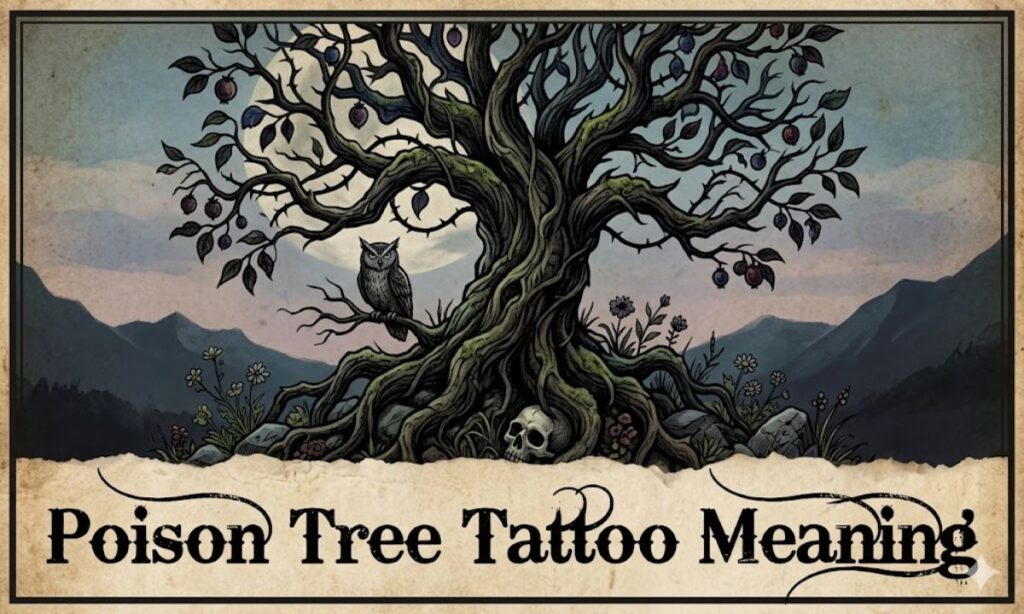
A poison tree tattoo depicts a tree — but not the kind associated with life, renewal, or peace. Think gnarled branches, dark twisted roots, shadowy bark, and sometimes a single gleaming piece of forbidden fruit. It is a visual metaphor, not a botanical portrait.
Unlike flourishing trees that represent growth and vitality, the poison tree leans into internal conflict: unspoken feelings, emotional toxicity, and the quiet destruction that comes from things left unsaid or unresolved.
At its core, the poison tree tattoo meaning is about what happens when we bottle up emotions — particularly anger — and let them grow in silence.
The Origins: William Blake’s “A Poison Tree” (1794)
The primary inspiration for this tattoo comes from English poet William Blake, who published the poem A Poison Tree in his Songs of Experience collection in 1794.
The poem opens with a powerful contrast:
“I was angry with my friend: I told my wrath, my wrath did end. I was angry with my foe: I told it not, my wrath did grow.”
Blake describes how unexpressed anger — when watered with fear, deceit, and false smiles — grows into a poisonous tree bearing deadly fruit. The narrator’s enemy eventually eats the apple and is destroyed.
The poem is a psychological warning delivered in botanical metaphor. Suppressed wrath doesn’t fade. It festers, grows roots, and eventually bears consequences. This literary symbolism has resonated with tattoo enthusiasts for generations, turning Blake’s short verse into some of the most emotionally powerful body art in existence.
Beyond Blake, the symbol also connects to:
- Greek mythology: The golden apples of the Hesperides — beautiful, guarded, and dangerous
- Christian symbolism: The Tree of Knowledge in the Garden of Eden, representing temptation and forbidden knowledge
- Norse mythology: The serpent Níðhöggr gnawing at the roots of Yggdrasil — decay beneath the surface of life
- Buddhist philosophy: The idea that unaddressed anger poisons the one who carries it
Poison Tree Tattoo Meaning: Core Symbolism
The meaning of this tattoo is multi-layered and personal. Here are the most widely shared interpretations:
| Symbolism | What It Represents |
| Suppressed anger | Emotions that grow destructive when kept inside |
| Betrayal or heartbreak | Pain from deceit, loss, or broken trust |
| Caution | A personal warning about emotional boundaries |
| Inner conflict | The silent battle between how you feel and how you present yourself |
| Transformation | Growth that comes after surviving emotional darkness |
| Self-awareness | Acknowledging the shadow self rather than denying it |
| Protection | A reminder to guard your peace and prune toxic influences |
| Lessons learned | The cost of bitterness, and the wisdom that follows |
What makes this tattoo especially meaningful is that it doesn’t celebrate darkness — it acknowledges it. People who choose this design have usually sat with their own capacity for emotional pain and decided to mark it permanently. That’s an act of self-awareness, not self-destruction.
Who Gets a Poison Tree Tattoo — and Why
This isn’t a tattoo people pick off the wall on impulse. The people who wear it tend to have a specific reason.
Those who grew up suppressing emotions. Many wearers describe households where expressing anger was unsafe or unwelcome. They learned to smile through fury. The tattoo marks the moment they recognized that pattern and decided to change it.
Survivors of toxic relationships. The poison tree speaks directly to those who’ve experienced betrayal — romantic, familial, or professional. It represents both the damage done and the decision to move forward.
Literature lovers and creative thinkers. Blake’s poem connects to a long tradition of dark romanticism. People who appreciate Edgar Allan Poe, gothic art, and emotional complexity often find the poison tree tattoo fits naturally into their worldview.
Those in emotional recovery. Therapy culture has embraced this tattoo as a symbol of healing. Some therapists and counselors note that the poem can be read as an invitation to release buried pain — not just a warning about what happens when you don’t.
Popular Design Variations
The poison tree tattoo isn’t one fixed image. Artists and wearers bring enormous creativity to the concept. Below are the most common design approaches:
Black and Grey Gothic Style
Twisted, leafless branches. Deep shadows. Gnarled roots spreading wide. This is the most traditional interpretation — serious, brooding, and visually striking. Often paired with ravens, skulls, or a full moon for extra atmosphere.
Blake-Inspired Illustration
Some wearers incorporate handwritten lines from the poem itself, etched along branches or beneath the roots. This makes the literary connection explicit and deeply personal.
Half-Dead, Half-Living Tree
One side blooming, the other decaying. This design captures duality perfectly — the coexistence of healing and pain, growth and destruction. It represents emotional balance, not resolution.
Serpent and Fruit Motif
A nod to temptation and forbidden knowledge. A snake coiled around the branches alongside a glowing apple echoes both Blake’s poem and biblical symbolism, adding layers of meaning.
Heartfruit Design
The forbidden fruit takes the shape of a heart. This variation emphasizes love’s darker side — attraction that harms, connections that corrupt, affection turned toxic over time.
Minimalist Line Art
Clean, simple, quiet. A sparse outline of a bare tree. This version is popular with those who want the symbolism without the dramatic visual weight. It suggests seeing clearly, thinking without emotional fog.
Watercolor Style
Fluid, expressive, vivid. Watercolor poison trees trade gothic heaviness for emotional intensity expressed in color. Deep reds, muted greens, and inky blacks create something that feels alive and raw.
Also Read this Meaning: Shee Foo Meaning
Color Meanings in Poison Tree Tattoos
Color dramatically shifts how this tattoo reads:
- Black and grey — Internal, serious, reflective. The most common and most emotionally grounded choice.
- Deep red — Passion, resentment, and the pulse of slow-burning anger
- Dark green — The slow, organic growth of something toxic left unaddressed
- Blood red fruit — Consequences made visible; the literal result of buried emotion
- Blue or teal — An unsettling, otherworldly tone — suggesting resentment that has become almost supernatural in its intensity
- Muted earth tones — Groundedness, survival, resilience after hardship
Best Placement Options for a Poison Tree Tattoo
Where you place this tattoo carries its own layer of meaning.
| Placement | What It Communicates |
| Forearm | Openness and visibility — you’re not hiding your story |
| Back | A statement piece; what you’ve left behind or carry silently |
| Ribs | Private, personal — a reminder meant for you, not the world |
| Chest | Emotional weight carried close to the heart |
| Spine | Spiritual alignment; strength rising from the core |
| Neck | Boldness and vulnerability; exposed emotion |
| Thigh or calf | Grounded, personal, easily revealed or concealed |
| Wrist or ankle | Subtle, intimate reminders of lessons learned |
The forearm remains the most popular choice — it’s visible to you constantly and to others in most social situations, which mirrors the idea of confronting rather than hiding emotional truth.
Psychological Dimension: Why This Symbol Resonates So Deeply
Modern psychology reinforces what Blake wrote centuries ago. Suppressed emotions don’t simply disappear. Research consistently links chronic emotional repression to anxiety, depression, immune dysfunction, and physical pain. The body keeps score even when the mouth stays shut.
Carl Jung’s concept of the shadow self — the parts of ourselves we bury or deny — maps directly onto poison tree symbolism. Acknowledging the shadow, rather than pretending it doesn’t exist, is the first step toward psychological integration. That’s exactly what this tattoo does: it brings the shadow into the light.
People who get a poison tree tattoo are, in many ways, doing shadow work in ink.
FAQ’s: Poison Tree Tattoo Meaning
Is a poison tree tattoo a negative symbol?
Not necessarily. It acknowledges darkness rather than celebrating it — confronting buried emotion is the first step toward healing, not a sign of something sinister.
Does a poison tree tattoo have to reference William Blake?
No, but Blake’s 1794 poem is the most recognized origin. Many wearers connect to the symbolism on a personal level without any literary background.
What does a poison tree tattoo mean for women?
The meaning is the same regardless of gender. Women often prefer watercolor or fine-line styles, but the symbolism — suppressed emotion, transformation, self-awareness — is universal.
Can a poison tree tattoo symbolize healing?
Absolutely. Many wearers choose it specifically as a marker of emotional recovery — proof that they recognized a destructive pattern and chose to grow beyond it.
What elements pair well with a poison tree tattoo?
Ravens, serpents, apples, moons, skulls, gothic script, and birds in flight are all popular companions. Each adds a specific layer of meaning to the core design.
How long does a poison tree tattoo take to complete?
Simple minimalist designs may take 2–4 hours. Detailed Gothic or realistic pieces, especially large back or sleeve designs, can require 8–12 hours across multiple sessions.
Conclusion
A poison tree tattoo is one of the most emotionally intelligent choices in body art. Rooted in William Blake’s timeless poem and layered with psychological, cultural, and personal meaning, it speaks to anyone who has ever felt the slow weight of unspoken anger or survived the fruit of unaddressed pain.
It isn’t a dark tattoo for dark’s sake. It’s a symbol worn by people who understand what emotional honesty actually costs — and what emotional repression ultimately destroys. Whether you choose it as a warning, a memorial, a transformation marker, or a literary tribute, the poison tree tattoo carries a meaning that ages as deeply as you do.

Shoaib Ahmed is a passionate content writer and language enthusiast who specializes in simplifying complex words, slang, and abbreviations into easy-to-understand meanings. As the creator of MeanFind.com, he is dedicated to helping readers quickly find clear and accurate definitions without confusion.