
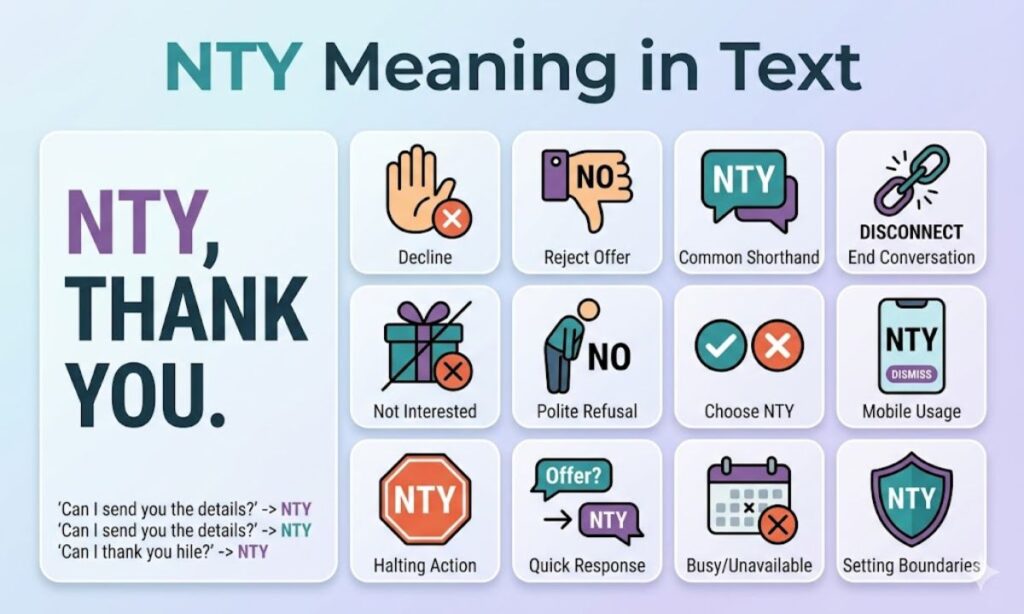
If you’ve ever received a message that simply said “NTY” and spent a moment wondering whether to feel offended or just confused — you’re in good company. Digital communication moves fast, and three-letter abbreviations can carry a lot of weight in a short space. So what exactly does NTY mean in text, and is it polite or rude?
This guide breaks it all down: the definition, origin, real-world examples, platform-specific usage, and everything else you need to confidently send (or receive) NTY in any conversation.
What Does NTY Mean in Text?
NTY stands for “No, Thank You.” It’s a short, casual abbreviation used in texting, online chats, social media, and gaming to politely decline an offer, invitation, or request. Rather than typing out the full phrase, people shorten it to three letters to keep conversations moving quickly while still sounding courteous.
Think of NTY as the digital equivalent of a polite head shake — brief, clear, and not aggressive.
Quick Definition:
| Abbreviation | Full Form | Tone | Common Platforms |
| NTY | No, Thank You | Neutral to polite | Texting, Discord, Gaming, DMs |
| TY | Thank You | Warm | Universal |
| NVM | Never Mind | Neutral | Casual chat |
| BRB | Be Right Back | Neutral | All platforms |
| LOL | Laugh Out Loud | Light/humorous | Universal |
The Origin of NTY
To understand where NTY came from, you have to picture the early days of mobile texting — flip phones, T9 keyboards, and per-character billing. Typing “No, Thank You” on a number pad required multiple taps per letter. Abbreviations weren’t just trendy; they were practical.
NTY emerged from that same era of internet shorthand that gave us BRB, LOL, and OMG. As instant messaging apps like AIM and MSN Messenger became popular in the early 2000s, users naturally compressed common phrases into quick codes. Over time, NTY found its place alongside other polite response shortcuts and has remained in active use ever since.
Today, despite the fact that most people type on full touchscreen keyboards, NTY has stuck around. Why? Because brevity is still valued in fast-paced digital conversations — and NTY strikes the right balance between politeness and efficiency.
How NTY Is Used in Real Conversations?
Context shapes everything when it comes to texting slang. NTY can appear in many different scenarios, from a casual group chat to a gaming trade window. Here are some realistic examples:
Casual Texting
- Friend: “Want to come to the gym this evening?”
- You: “NTY, I’m pretty wiped out today. Maybe Thursday?”
Social Media / DMs
- Stranger: “Hey, want to follow-for-follow?”
- You: “NTY, but thanks for reaching out!”
Online Gaming
- Player: “Wanna trade your rare sword for my shield?”
- You: “NTY, I need the sword for the next quest.”
Group Chats
- Organizer: “Who’s in for karaoke Friday night?”
- You: “NTY 😅 I’ll skip this one.”
In each of these situations, NTY communicates a clear “no” without shutting down the conversation entirely or sounding dismissive. Adding a follow-up sentence or an emoji can make it feel even warmer.
Is NTY Rude?
This is one of the most common questions people have — and the honest answer is: it depends on the context and your relationship with the person.
Here’s a simple breakdown:
- Between close friends: NTY feels completely natural. They know your communication style and won’t read into it.
- In online gaming: Perfectly acceptable. Trade declines and squad rejections happen constantly, and NTY is a standard, efficient response.
- With acquaintances or new contacts: It can feel slightly abrupt. Adding a brief explanation softens it considerably.
- In professional or formal settings: Avoid it entirely. Stick to “No, thank you” in full, especially in emails or business messages.
The abbreviation itself is not inherently rude — but tone, platform, and relationship all influence how it lands. A simple “NTY, appreciate the offer though!” reads very differently from a cold, standalone “NTY.”
NTY Across Different Platforms
The meaning of NTY stays consistent, but how it’s received can vary by platform:
Texting & WhatsApp
Standard use for declining invitations or plans. Works best among people who already know each other well.
Discord & Gaming Chats
Very common here. Used to decline trade offers, team-up requests, or shared game invitations. Completely normal and expected in these fast-paced environments.
Instagram & TikTok
Sometimes used humorously in comments. For example, someone might write “Everyone’s doing this trend? NTY 😂” as a playful rejection of a popular challenge.
Snapchat
Often used in quick, informal exchanges where long replies feel out of place.
Professional Tools (Slack, Teams)
Risky territory. NTY might be fine in a casual team chat, but in any client-facing or formal thread, it’s better to write it out in full.
Also Read This Meaning: PTSO Meaning in Text
Other Possible Meanings of NTY
While “No, Thank You” is overwhelmingly the most common interpretation, NTY can occasionally carry other meanings depending on context:
- “Not This Year” — Used in planning or decision-making conversations
- “Not Your Type” — Sometimes appears in dating app conversations, though rarely
- Gaming-specific slang — In niche gaming communities, abbreviations sometimes shift meaning, so it’s always worth reading context
That said, if you see NTY in a standard text or chat message, “No, Thank You” is almost certainly what the person means.
Polite Alternatives to NTY
Not sure NTY fits the moment? Here are some alternatives that carry a similar message but let you adjust the tone:
| Alternative | Tone | Best For |
| No thanks | Friendly | Most casual situations |
| I’ll pass | Casual | Friends and peers |
| Not interested | Direct | Sales/spam replies |
| Maybe later | Soft refusal | Keeping options open |
| Thanks, but no | Warm | Acquaintances |
| I appreciate it, but no | Formal-ish | Semi-professional settings |
The right choice depends on how well you know the person and how you want the conversation to continue.
How to Respond When Someone Sends You NTY?
Receiving NTY doesn’t have to be awkward. Here’s how to respond gracefully depending on the situation:
- Social invite: “No worries! Maybe next time 😊”
- Business or sales: “Completely understood. Feel free to reach out if anything changes.”
- Gaming offer: “Cool, no worries! GG.”
- Group plan: “Got it! Let me know if you change your mind.”
The key is not to push back or make the person feel pressured. NTY is a complete answer — respect it and move on.
Common Misconceptions About NTY
Misconception 1: NTY is always cold or dismissive. Not true. In the right context, it’s a perfectly friendly and efficient way to decline.
Misconception 2: Only teenagers use this kind of slang. Adults of all ages use NTY, especially in gaming and casual digital communication.
Misconception 3: NTY means you’re permanently uninterested. It usually refers to the specific situation at hand, not a blanket rejection.
Misconception 4: You always need to explain yourself after NTY. Sometimes a simple decline is enough. Add context when the relationship calls for it — but you’re not obligated.
Conclusion
NTY is one of those small abbreviations that punches above its weight in digital communication. At its core, it simply means “No, Thank You” — a fast, polite refusal suited for texting, gaming, and casual online chat. But as with most text slang, the real meaning lives in the context, tone, and relationship behind it.
Used thoughtfully, NTY is a clean and effective communication tool. Used carelessly in the wrong setting, it can come across as dismissive. The key is knowing your audience: keep it among friends, gamers, and informal platforms — and opt for the full phrase when the conversation calls for a bit more care.

Shoaib Ahmed is a passionate content writer and language enthusiast who specializes in simplifying complex words, slang, and abbreviations into easy-to-understand meanings. As the creator of MeanFind.com, he is dedicated to helping readers quickly find clear and accurate definitions without confusion.