
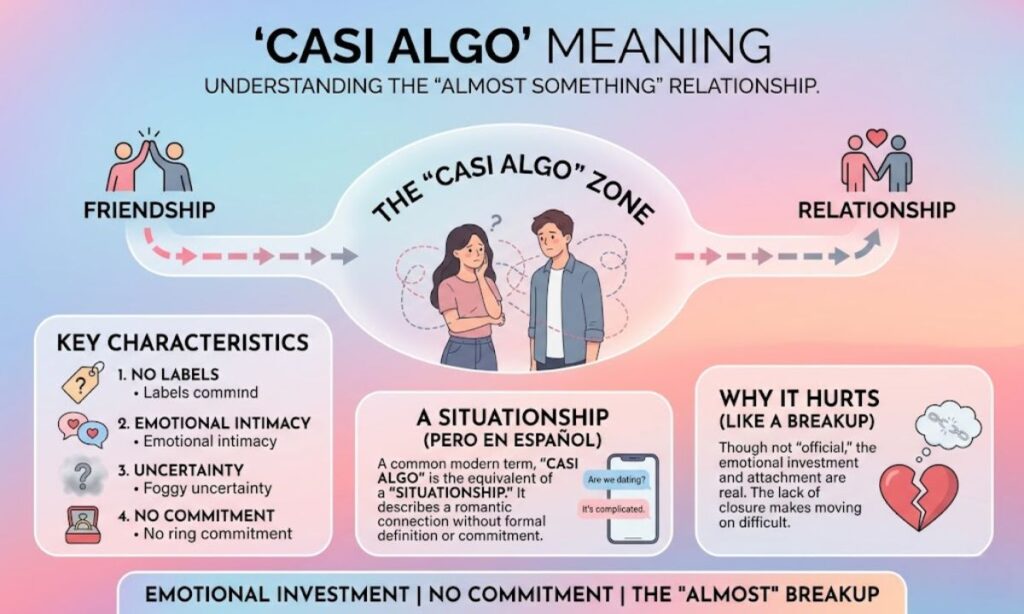
Have you ever been in a situation with someone where things felt real, meaningful, and full of potential — but nothing was ever officially defined? No label, no commitment, yet too much emotion to call it nothing? That’s the exact feeling the Spanish phrase casi algo was made for.
If you’ve seen it trending on TikTok, heard it in a Spanish song, or spotted it in a caption with a heart emoji, this guide will explain everything — what casi algo means, where it comes from, how it’s used today, and why millions of people across the world instantly recognize the feeling it describes.
What Does Casi Algo Mean?
Casi algo is a Spanish phrase that literally translates to “almost something” in English. But like most powerful expressions, the literal translation barely scratches the surface.
In modern usage, casi algo describes a connection — usually romantic — that feels real and emotionally loaded, but never gets a name or a label. It sits in the gray zone between friendship and a committed relationship. More than casual, less than official. Deeply felt, but frustratingly undefined.
| Spanish Word | English Translation | Example |
| Casi | Almost / Nearly | Casi gané — I almost won |
| Algo | Something / Anything | Quiero algo — I want something |
| Casi algo | Almost something | An undefined connection with emotional depth |
Think of it as the Spanish-speaking world’s answer to the English term “situationship” — but with far more emotional nuance and poetic weight.
The Origin of Casi Algo
The phrase didn’t emerge from a dictionary or a formal linguistic decision. It grew organically, the way the best slang always does — out of real lived experience.
Casi algo took root in Latin American youth culture, particularly in Mexico, Colombia, and Spain, during the early 2010s. Young people in Spanish-speaking communities needed a way to describe the messy, undefined romantic situations they were living through — relationships that didn’t fit into traditional categories.
As dating apps transformed how people met and connected, and as social media platforms like Instagram, Twitter, and later TikTok gave everyone a stage to share their emotional lives, the term traveled fast. By the mid-2010s it was appearing in YouTube relationship videos, song lyrics, and viral memes. By 2020 it had become a defining phrase of modern dating culture — not just in Latin America, but globally, especially in bilingual Gen Z and Millennial communities.
Songs like “Tu Casi Algo” by Xavi helped romanticize and amplify the concept, making it resonate with young people who immediately recognized the feeling being described.
Casi Algo in Relationships: What It Looks Like in Real Life
The casi algo dynamic is incredibly specific — and incredibly common. Here’s what it typically looks like:
- You text each other every single day
- You go on dates, but neither of you calls them dates
- There’s clear emotional and physical closeness
- Friends ask “so what are you two?” and neither of you has an answer
- One or both people feel something deeper, but nobody says it out loud
- The “What are we?” conversation never happens
It’s the talking stage that never graduates into a relationship. It’s the person you introduce as “a friend” while your heart does something completely different. It’s real feelings without a real definition.
Real-Life Examples of Casi Algo
- “Somos casi algo” — We are almost something (we act like a couple, but we’re not official)
- “Ella fue mi casi algo” — She was my almost something (a relationship that never became official)
- “Mi casi algo me tiene loco/a” — My almost-something is driving me crazy (the confusion and longing of undefined connection)
The phrase “mi casi algo” — meaning “my almost something” — is particularly intimate. It refers to a specific person who held emotional significance without ever formally claiming the role. It’s bittersweet by nature.
Why Casi Algo Hits Different Than “Situationship”
Both terms describe similar territory, but they don’t feel the same. Here’s why casi algo has taken on a life of its own even among English speakers:
| Feature | Casi Algo | Situationship |
| Language origin | Spanish (Latin American slang) | English (modern dating culture) |
| Tone | Poetic, emotionally warm | Clinical, descriptive |
| Cultural weight | Carries longing and nostalgia | More neutral, analytical |
| Usage | Social media, music, personal conversation | Dating advice, psychology discussions |
| Feeling conveyed | “Almost something beautiful” | “An undefined romantic situation” |
English has practical words for undefined relationships, but casi algo captures the feeling of them — the hope, the confusion, the tenderness, and the ache — all in two words. That’s why even non-Spanish speakers now use it. It simply fits better.
The Emotional Psychology of a Casi Algo
Being in a casi algo isn’t just confusing — it’s genuinely emotionally complex. The undefined nature of the connection creates a push-pull psychological experience:
- Hope and anxiety coexist. Every message feels meaningful. Every silence feels like rejection.
- You’re emotionally invested without any guarantee. The feelings are real, but so is the uncertainty.
- It’s harder to grieve than a real breakup. When a casi algo ends, there’s often nothing concrete to point to — no official relationship, no clean ending.
- Mixed signals become the norm. One day everything feels like it’s building toward something. The next, nothing moves forward at all.
This is why people often say: “A casi algo hurts more than a breakup — because there’s nothing official to grieve, yet everything still hurts.”
The ambiguity itself becomes a kind of emotional trap. The undefined status makes it easy to stay stuck, hoping things will eventually move forward without either person having to commit to anything directly.
Casi Algo Beyond Romance: Other Uses of the Phrase
While casi algo is most strongly associated with romantic relationships, its meaning stretches further than that. It can describe any situation that felt close to meaningful but never fully arrived.
- Career: A promotion that was hinted at for months but never delivered. A job opportunity that almost materialized. The feeling of professional near-success.
- Friendships: A close connection that almost became a deep friendship, but faded before it got there.
- Dreams and goals: A project, a business idea, or a personal milestone that felt within reach but slipped away.
In all these contexts, casi algo captures the same core emotion — the particular sting of almost, the frustration of proximity without completion.
Also Read This: MYF Meaning in Text
Casi Algo on Social Media and in Pop Culture
The phrase has exploded across digital platforms, becoming a fixture of modern online conversation:
- On TikTok, hashtags like #CasiAlgo and #AlmostSomething rack up millions of views. Users post videos about mixed signals, undefined connections, and the emotional toll of relationship limbo — set to music, of course.
- On Instagram, people use casi algo in captions, Reels, and story slides to describe their romantic situations with humor, nostalgia, or vulnerability.
- In Spanish-language music, the concept appears frequently — songs about love that was almost, connection that never got to be official, feelings that had no name.
- Even meme culture has embraced it. Relatable posts like “My love life: 0 relationships, 3 casi algos” go viral because they speak to a universally shared modern experience.
The global reach of casi algo shows that the feeling it describes isn’t cultural — it’s human. People across languages and backgrounds recognize it immediately because they’ve lived it.
How to Navigate a Casi Algo Situation
If you’re currently stuck in one, here are some honest, practical steps to find clarity:
- Name what you’re feeling. Acknowledge to yourself that the connection matters and that the undefined nature is affecting you.
- Communicate directly. Hints and subtle signals rarely move things forward. A clear, honest conversation about where things are headed is the only real option.
- Set a personal timeline. Decide privately how long you’re willing to exist in the undefined zone — and respect that boundary.
- Watch actions, not just words. Someone who wants to be with you will find a way to be with you. Consistency matters more than what anyone says.
- Prioritize your emotional wellbeing. If the casi algo is causing more stress than joy, that’s important information about whether it’s worth holding onto.
Romantic ambiguity can be exciting at the start, but it has a shelf life. At some point, clarity becomes essential — for both people involved.
Frequently Asked Questions
What does casi algo mean in English?
Casi algo translates directly to “almost something” — used to describe an undefined connection that feels real but never becomes official.
Is casi algo the same as a situationship?
Yes, essentially. Casi algo is the Spanish emotional equivalent of a situationship, but with more poetic and culturally nuanced weight.
What does “mi casi algo” mean?
Mi casi algo means “my almost something” — a personal way to refer to the specific person who was almost, but not quite, your partner.
Where did casi algo come from?
It originated in Latin American youth slang, particularly in Mexico and Colombia, and spread globally through social media and Spanish-language music in the 2010s.
Can a casi algo become a real relationship?
Sometimes — but only if both people are willing to have an honest conversation about what they want and choose to move toward commitment together.
Is casi algo used only in romantic contexts?
No. While romance is the most common context, casi algo can also describe career near-misses, almost-friendships, or any situation that felt close to meaningful but never fully materialized.
Why do English speakers use casi algo instead of “situationship”?
Because casi algo carries emotional warmth and a sense of longing that “situationship” doesn’t quite capture — it sounds and feels closer to the actual experience.
Is casi algo slang or a real Spanish phrase?
It’s both. Casi and algo are real everyday Spanish words. Their combination into casi algo as a relationship term started as slang and became a widely recognized cultural expression.
Conclusion
Casi algo is more than a trending phrase — it’s a precise and emotionally honest way to name one of the most common experiences in modern relationships. Two ordinary words in Spanish came together to describe something that millions of people feel but struggle to put into language: the experience of almost, the weight of undefined connection, and the particular kind of longing that comes with something that never got to become real.
Whether you’ve lived through a casi algo, are currently in one, or are just learning the phrase for the first time — understanding it helps. It validates the experience, gives it language, and reminds you that the feeling of “almost something” is one of the most universally human experiences there is.

Shoaib Ahmed is a passionate content writer and language enthusiast who specializes in simplifying complex words, slang, and abbreviations into easy-to-understand meanings. As the creator of MeanFind.com, he is dedicated to helping readers quickly find clear and accurate definitions without confusion.